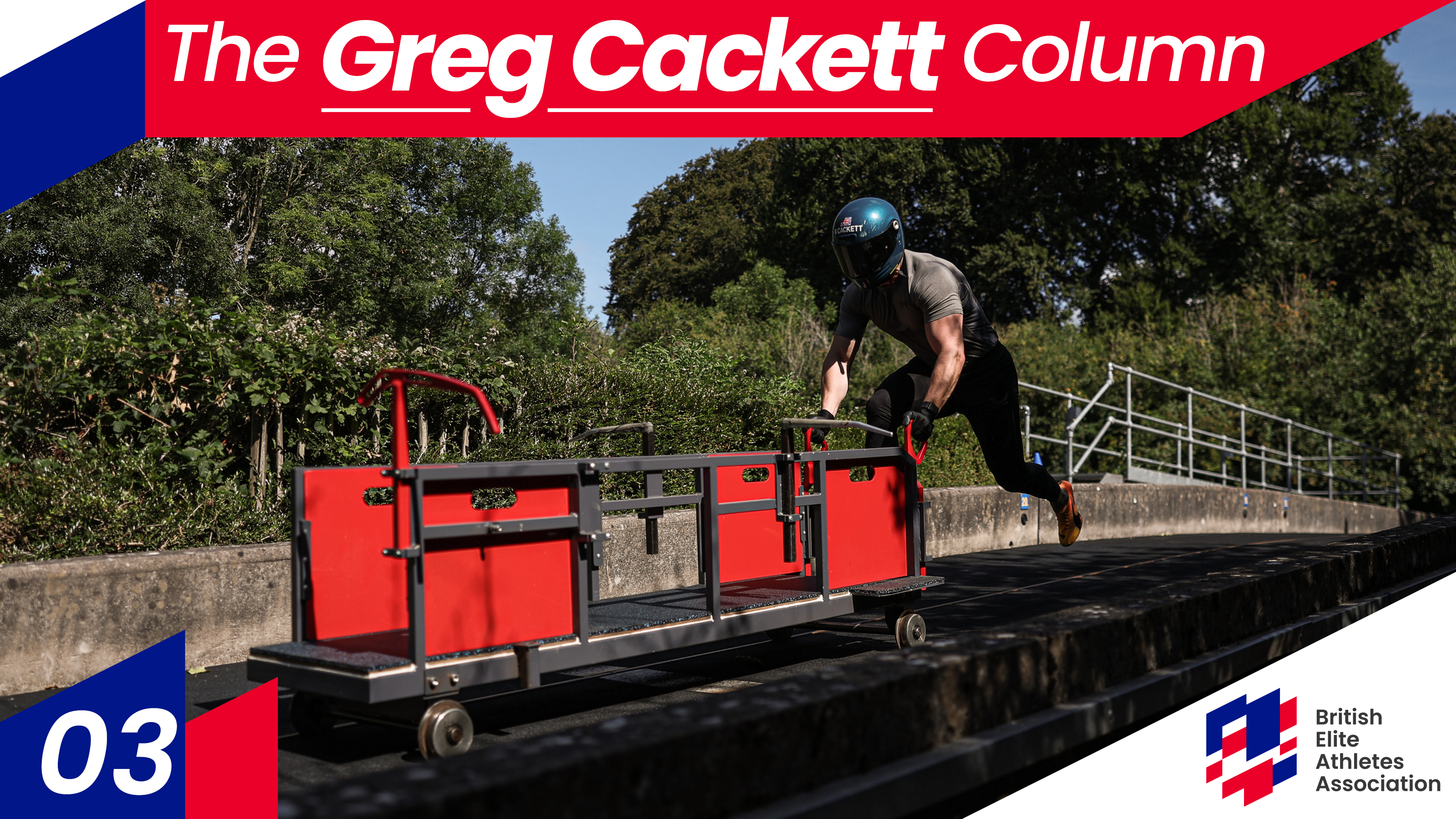
The Greg Cackett Column is a new series from the BEAA and Greg, a three-time Olympic bobsledder and freelance writer, who has been published by the BBC and the Sunday Times. With an irreverent and lighthearted style, Greg will be digging into what goes beyond athlete identity and, in this edition, he discusses what athletes must consider before committing to another Olympic or Paralympic cycle.
The dust has settled. The Olympics/Paralympics are over.
Maybe you made the team, maybe you didn’t. Maybe you finally won the medal, maybe it eludes you. Maybe your motivation account is empty, maybe there are deposits still to be made.
Whatever the ‘maybe’, your near-future dilemma looms… do I swim/cycle/bob/straight salto into the sunset? Or…
Do I go again?
Like an American President’s rabid supporters your inner voices cry: ‘FOUR! MORE! YEARS!’
Meanwhile your tendons, ligaments and mental scars cry - well… they just cry.
It’s a scenario many athletes will be familiar with and something I’ve wrestled with myself since Milan Cortina. And knowing elite athletes like I do, if you’re thinking about it, you’re probably gonna do it.
Now, you might be young, cool and hip, and another Olympic/Paralympic quad is a no-brainer. Or you might be old, cold with a sore hip, and the prospect is less appealing.
Either way, ‘going again’ requires thought. Let’s look at two obvious considerations with a final, critical question.
Athletes know better than anyone how our choices weigh heaviest on those closest to us.
So, are partners/families on board? Did you pinky promise this Games was the last one and change your mind?
I've often found with this particular conversation that casting off lazy assertions of athlete 'selfishness' is helpful. Some athletes lean into the selfishness thing- 'we’ve got to be selfish unfortunately'.
Well yeah, us and every other human chasing a high-performing career. It’s a reductive and damaging view. I hated being called selfish for chasing the Olympic dream.
'Selfishness' as it pertains to a sporting career is different in my opinion. It is a duty to the emptying hourglass that is your talent and ability.
And whilst you should never dismiss loved one’s concerns, equally don’t mistake their concerns for your final answer.
In a previous relationship, I was almost guilt-tripped out of starting a bobsleigh career because I’d be out of the countryfor the winter months. That career has given me three Olympic Games, my closest friendships and the greatest experiences of my life so far.
The scariest part: I'm not with that person anymore. What I would’ve missed.
Giving space to once-in-a-lifetime dreams doesn't mean you fail to recognise the pressures another quad willprovide. I’m not saying you don’t do the work to soften those edges as much as possible - you absolutely do.
I’m saying, don’t pass on this life unless it is absolutely the right decision - for you.
Forcing ‘rational’ choices about something as inherently irrational as chasing an Olympic or Paralympic dream can be dangerous for relationships.
Give it up before you’re ready and you give resentment a place to fester.
Choosing to remain in sport can feel less and less responsible given the remuneration and suspect career transferability on offer.
I know at times the longer I stayed in sport, the more ridiculous it looked on paper. Or that’s what I felt anyway. We can’t all have lucrative knitting side-quests.
Working alongside training is possible, although don’t earn beyond the means testing threshold or you’ll risk losing your APA!
Is there anything more wonderfully British than a system of encouraging athletes to become more financially independent by financially penalising them for becoming more financially independent? Slightly tongue in cheek there. Eligibility criteria is important where public money is concerned. It just doesn’t make life any easier for athletes at the coalface.
There are ‘career transition’ initiatives to support athlete leavers but these are by no means a guarantee of a soft landing - or even something you’re interested in.
You can agonise over whether the job you’re interviewing for is what you want, blissfully unaware you didn’t get it anyway.
I can speak to this situation because I’m living it. I interviewed with Amazon for interview experience. Whilst I had no intention of working for them, their rejection didn’t sting any less.
Elite sport seems to have done strange things to my relationship with accomplishment. Being rejected from a job I didn't want felt remarkably like losing!
As athletes we have become accomplished in a narrow world that might suddenly cease to exist. That can be scary. And just because you’re funded, doesn’t mean there isn’t a cost to staying in it. Also scary.
Does staying in sport feel like you’re being left behind in other aspects of your life or is Olympic/Paralympic immortality still a big enough goal?
Which brings me to that final, critical consideration. Do you still love it?
Not necessarily the sport itself (it helps). I mean the chase. The dream.
The chaos.
Do you still want to find out how good you could be? Does that possibility still make the morning pain, the rehab, the airports, the financial uncertainty and another quadrennial putting normal life on hold feel worth it?
If the answer’s no, then ‘going again’ is a big ask no matter how supportive your networks or plantar fascias are.
If the answer’s yes, well, listen to the voices I guess: FOUR. MORE. YEARS.